18 JUNE 2026 · INTERVIEW
Back to the origin — an interview with Wim
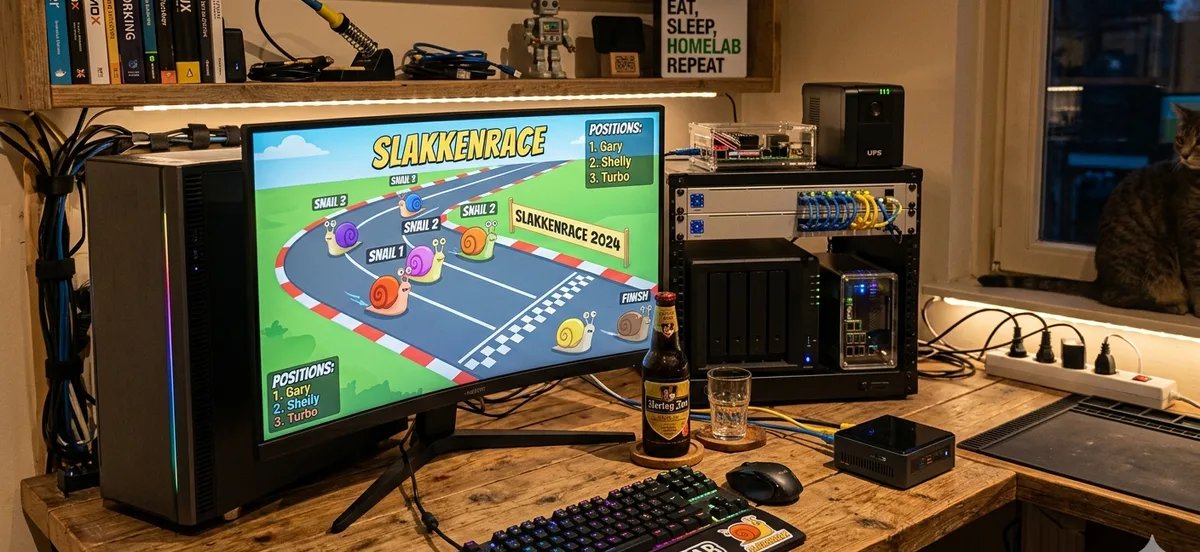
wvorigin started as a homelab experiment and grew into a small, independent game studio with one belief: a game should be fun first. We sat down with Wim — who leads the homelab studio — to talk about where the idea came from, why finishing last is winning, and why everything runs in the Netherlands. The throughline: go back to the origin, then grow into something you cannot even imagine yet.
How did the idea for wvorigin come about?
wvorigin started as a way to explore what is possible with AI, and to build something meaningful. On that journey we went back to the origin — to when I was young and played games. That nostalgia became the foundation.
Finishing last to win is counter-intuitive and brilliant. Where did that come from?
The inspiration was born from the Brand Slakkenrace. Over a beer, looking back on our youth, the game came up. The Brand Slakkenrace (snail race), a game handed out on CD-ROM in 1998 by the Brand brewery. In it you played a snail and had to finish last; your weapons sped your opponent up instead of slowing them down. We rebuilt that core — in the browser, with modern features, our own twist and our own identity. Inspired by the snail race, but entirely new. More on the Brand Slakkenrace on Wikipedia.
You built everything yourself, including your own engine. Why not Unity or Godot?
We started with JavaScript and built a custom engine from scratch, simply because we could. The game engine itself is all JavaScript; for the online side — the multiplayer relay and the leaderboard — and a few supporting services we use Go. Snail Racer did not need a heavy, complex engine — the techniques were not that complicated. But we made something special out of it. For future games we are not ruling out existing engines like Unity or Godot. We are open to whatever makes sense.
You host everything in the Netherlands, not on AWS or Google Cloud. What drove that?
We started as a homelab project, a small hobby effort. We wanted to avoid depending on American software and infrastructure — not because we are against American companies, but to reduce geopolitical risk. We are not fully independent; we still use Cloudflare and American tools. But the game itself and our core hosting are in the Netherlands, and we have set up our infrastructure so we can switch providers easily. We use the best tools, but we do not let ourselves get locked in.
You are exploring ads to keep games free. What is your approach?
AdSense approval is still pending, and honestly, ads are not our top priority. We prefer contextual advertising over personalised tracking — more privacy-friendly, simpler to build, less GDPR complexity. When we launch on Google Play or iOS that might change, but we want to do it differently than our competitors: minimise ads, and keep just enough to pay for hosting. Hosting costs money — but we are trying to prove there is another way.
Snail Racer is live with online multiplayer. How do you work with your community?
The community matters a lot. We have a small, close-knit group of testers who give us constant feedback. We do not need a huge community right now — a handful of dedicated people is better. We want to grow, but organically. The motto: go back to the origin, then grow into something you cannot even imagine yet.
The soundtrack is generated procedurally in the browser, with no audio files at all. How did that come about?
The entire soundtrack is generated live in the browser with the Web Audio API — not a single audio file. Easy, fast, unique and low-maintenance. We pragmatically built something that works and sounds good without constant upkeep. What is there is good enough; if the future asks for something else, we will adapt.
Beyond the snail race — where does your inspiration for future games come from?
Back to the origin. In my youth I played all kinds of games I have fond memories of — Total Annihilation, Age of Empires, Freddi Fish, Pokémon Gold, Yu-Gi-Oh, FIFA, GTA, Minecraft and of course the Brand Slakkenrace, and many more. Those games felt pure, without the modern bloat. That is our foundation: recapturing that feeling, with a modern twist.
What has been your biggest challenge so far, and what did you learn?
Automated testing is critical. Snail Racer worked perfectly on Safari and iPhone, but on Android and Chrome it was painfully slow. The cause was in Endless mode: that track is effectively endless — about 80 million pixels — and we generated the roadside decoration across the whole track ahead. That became millions of objects that the draw loop walked every single frame. On a Pixel 8 it dropped to one frame per second, while iPhone did not even show the problem. Our testers caught it. The fix: we now generate only a finite band of decoration and let it wrap and repeat. We now have automated tests that check each release against past mistakes — but we still need to widen that coverage. Real testers plus automated tests: that is the winning combination.
Where do you want wvorigin to be in three years?
More games, played by many more people, all running smoothly. But wvorigin will not be only games. We will expand into tech content — tips and inspiration — to help people grow from their own origin into something great. For what is coming next, see the roadmap.
Want to follow along or share an idea? Follow the devlog or reach us via the contact page.